After we had travelled to Canada for the first dish of this blog I had considered many next destinations. I had a look at more exotic locations and more basic things but in the end a conversation with friends of mine was the deciding factor. I talked about my idea of making this blog and they asked me a simple question: “What will you be cooking for Germany?”. And honestly, I could not tell them. After living here for all my life, I could not say in any way what a good representative national dish for my very own country would be.
And with that I began thinking and asking more friends and family what they thought would be the way to go. I even asked some friends from outside of Germany what they would expect from a traditional German dish. I got a whole range of different answers. The most common ones included sausage. Sausages have a long tradition in Germany and we have an awful lot of them around here, local variations and geographically limited products that can only be produced in or next to certain cities (think of the “Wiener Schnitzel” as a probably well-known similar thing). Honestly, we do indeed eat a lot of sausage. And they are good.
The next thing that often came up was Sauerkraut. Mostly from people not from Germany in all honesty. It’s a well-known fact that the “Krauts” love their Sauerkraut. Well… many of us don’t to be honest. Don’t get me wrong, it’s a dish that if well-made can be amazing and I would gladly eat it. But it’s not really something I would call a good representation of… well, myself.
A lot of other options came up and honestly, there was no way I could find a dish everyone agreed on. And the reasoning for that is simple: There simply is no “german” food. Germany is a country where regional differences are huge. That mostly stems from the fact that the first unification of Germany only took place in 1871 and then another division after WW2 caused another great difference in cuisine in different parts of Germany. So, all you can find in Germany is regional cuisine. And that one varies. It’s not necessarily only the dishes (although those already are quite different depending on where you are). It’s also the way you make the dish. Regional ingredients, small nuances… you probably won’t find two towns agreeing on the perfect way to make a dish.
And so I decided to go with a dish that maybe most Germans would not call a national dish, but one that I personally call representative of my life.
Öcher Suurbrödem.
It roughly translates to “sour roast from Aachen”. “Öcher” here is the local version of saying “Aachen”, a city in the west of Germany (quite close to the place I grew up in). “Suurbrödem” is local dialect for “Sauerbraten” which is the name more commonly known around Germany. I would call it traditional in the sense that probably every German knows the dish… but a different version of it. There are versions from the Rhine area, versions from Swabia, from Franconia, from Baden and many more. The Öcher version is the best version of the dish (which I obviously don’t say because it’s the one I grew up with…).
The basic idea is always the same: You take a (potentially cheap) cut of meat, marinade it in a vinegar-based marinade for roughly a week and then (after cooking it) you have an acidic, sour piece of very, very, very tender meat. You add a sauce to it and some sides, often potato or cabbage based.
The version I was going for has a lot of memories attached to it. My grandma made this dish for us when I was a lot younger and I will never forget coming to her house on a Friday after school and seeing the marinating meat sitting in the children’s room, signalling that Sunday will be a great meal day.
Sadly, I never got a hold of her recipe before she died. But I took what I could remember, looked around the traditional versions of making the dish and found something that is not exactly hers (you can never get as good as grandma…) but quite close and very tasty as well.
So, let’s get started with my take on the Öcher Suurbrödem.
The recipe consists of two steps and the sides.
First step is marinating the meat. You can go for basically any cut of meat. Traditionally you will use horse-meat for the Öcher version but you can easily substitute this with beef if you have moral concerns or (as in our case) no butcher nearby that has horse available. We went for the hip part of the beef. You can easily use a cheaper cut as well. The marinade will get any cut tender, just try to choose something without too many tendons.
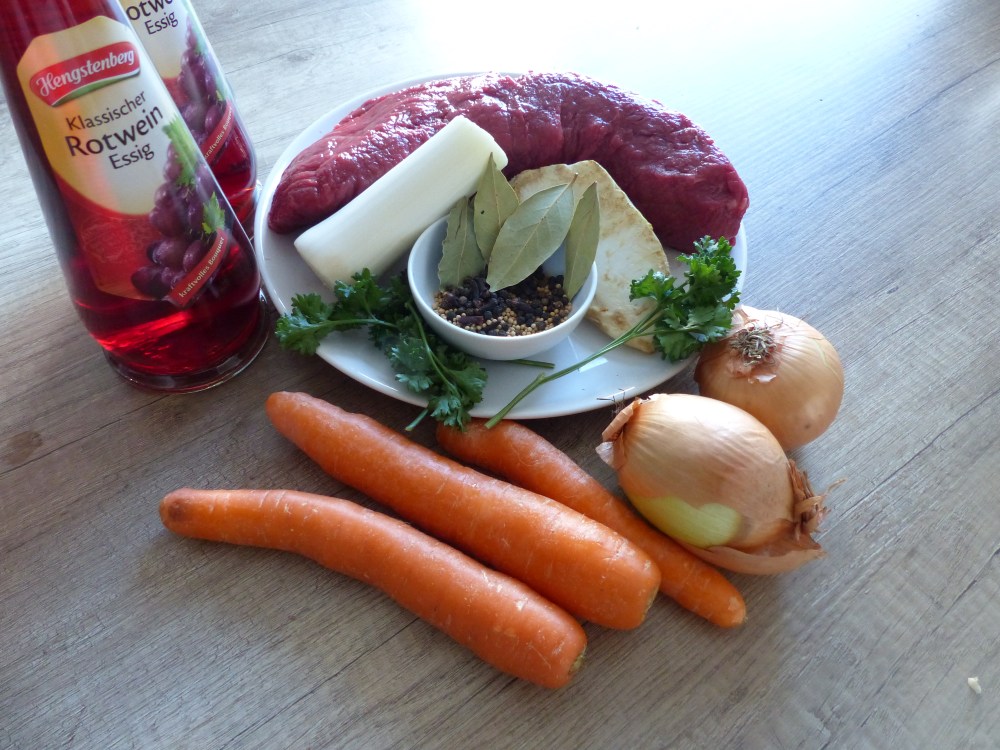
We went with 1kg of beef (that’s a good 3-4 portions in the end). For the marinade we took:
Ingredients:
500ml red wine vinegar
500ml water
Carrot
Celery root
Leek
Onion
5 Bayleafs
9 Cloves
1 tablespoon of black peppercorn
2 tablespoons of mustard seeds
Instructions:
- Mix everything together in a big bowl.
- Add the meat. Make sure it’s covered both top and bottom with vegetables.
That’s the first part done already. You now put some clingfilm on top of the bowl and place it in the fridge. And then you let it sit there for at least 4 days, best would be a week (I waited one week). Make sure you move the meat every 1-2 days, so it gets evenly marinated from all sides.
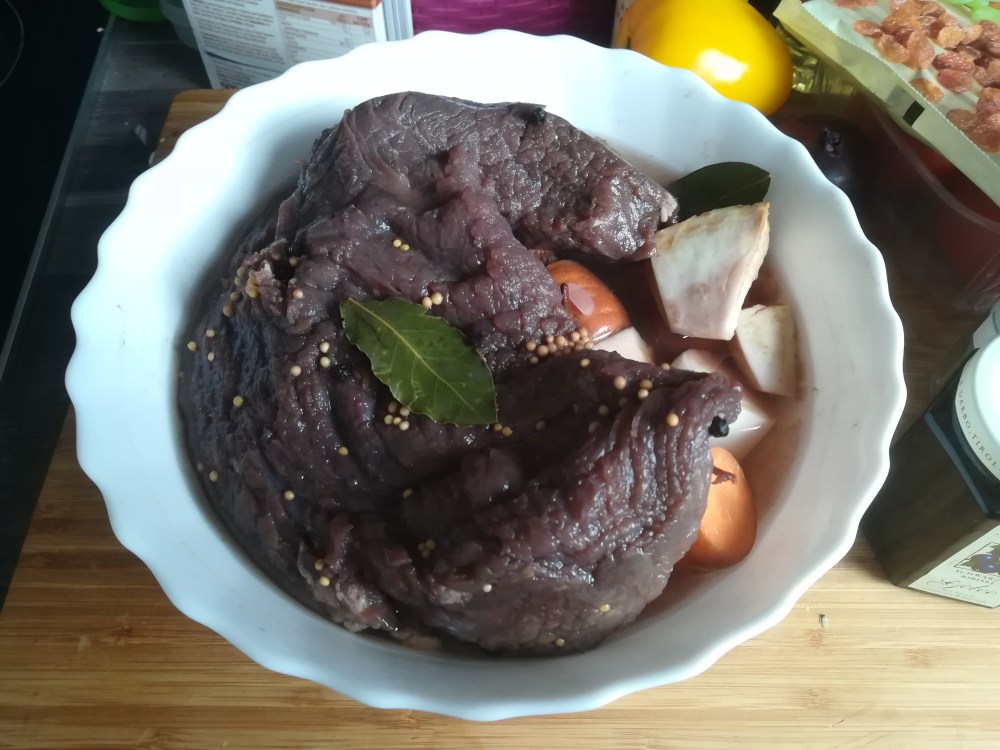
After impatiently waiting for a this time, your meat is finally prepared and the process of finishing it begins. You cook the meat in the sauce you serve it with in the end to get as much taste as somehow possible in there. Here is how I did it:
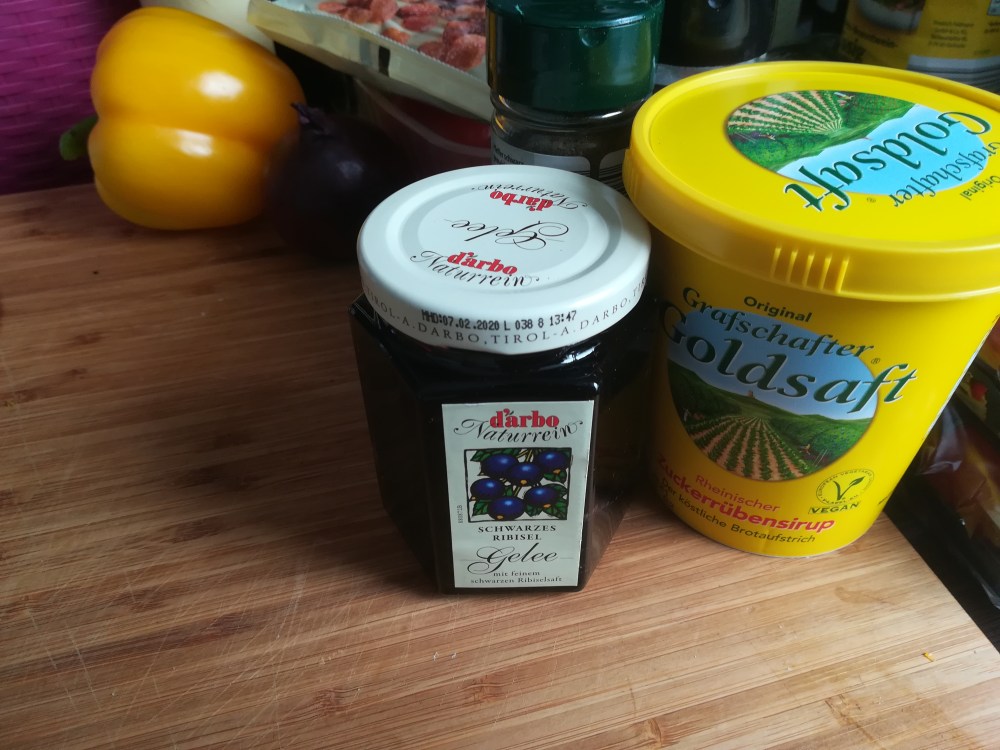
Ingredients:
The marinated meat (still in the marinade. Don’t throw that away!)
100g of raisins
3 tablespoons of sugar beet syrup
3 tablespoons of black currant jelly
50-100g of Öcher Kräuterprinten (which are hard to come by if you aren’t in Aachen. You can simply use gingerbread instead)
Olive Oil for searing
Instructions:
- Take the meat out of the marinade. Rinse it off.
- Sift the remaining marinade. Throw away all solid parts (vegetables + seeds, etc.)
- Heat up a pot, put in the olive oil. Sear the meat for a good 1-2 minutes from all sides. Make sure it gets a nice and brown surface.
- Turn down the heat. Sprinkle the meat with tablespoons of the marinade. Take a wooden spoon and scratch around the bottom of the pot to release the browned parts that should be stuck there. Repeat until you have all the marinade in the pot, cooking.
- Add the sugar beet syrup and black currant jelly. Let it cook for a good 10 minutes.
- Add the raisins and the Öcher Kräuterprinten (or gingerbread). Let it cook for about 2 hours. Stir frequently and drizzle the meat with the sauce.
- You are done.
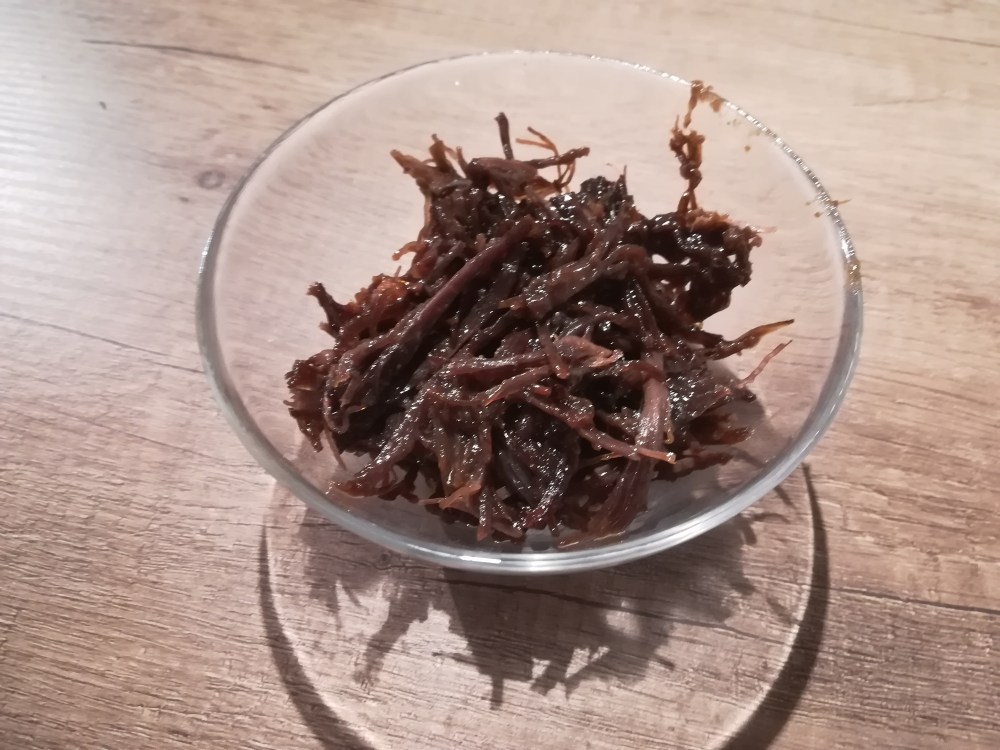
Once you are done, you will see that the roast lost a lot of weight. It should be roughly half the size it was when you started the process of marinating it. Also, some parts should have come loose, swimming in the sauce now. When you take out the roast to cut it you need to be very careful. Saying the meat is tender is really an understatement here. Just touching it makes it break down into small parts. My fiancée compared it to pulled pork and it is indeed basically the same consistency. It’s amazing. Cut it and add sides.
I went for potato dumplings and red cabbage. For the dumplings cook some potatoes, mash them, let them cool, add some potato flour and milk, make a nice dough, form balls and cook them in salt water. Red cabbage is normally bought premade as the process of making it yourself is long and tedious. I kept to this tradition as my grandma also always did it this way (which makes for a great excuse to do things the fast and easy way I guess).
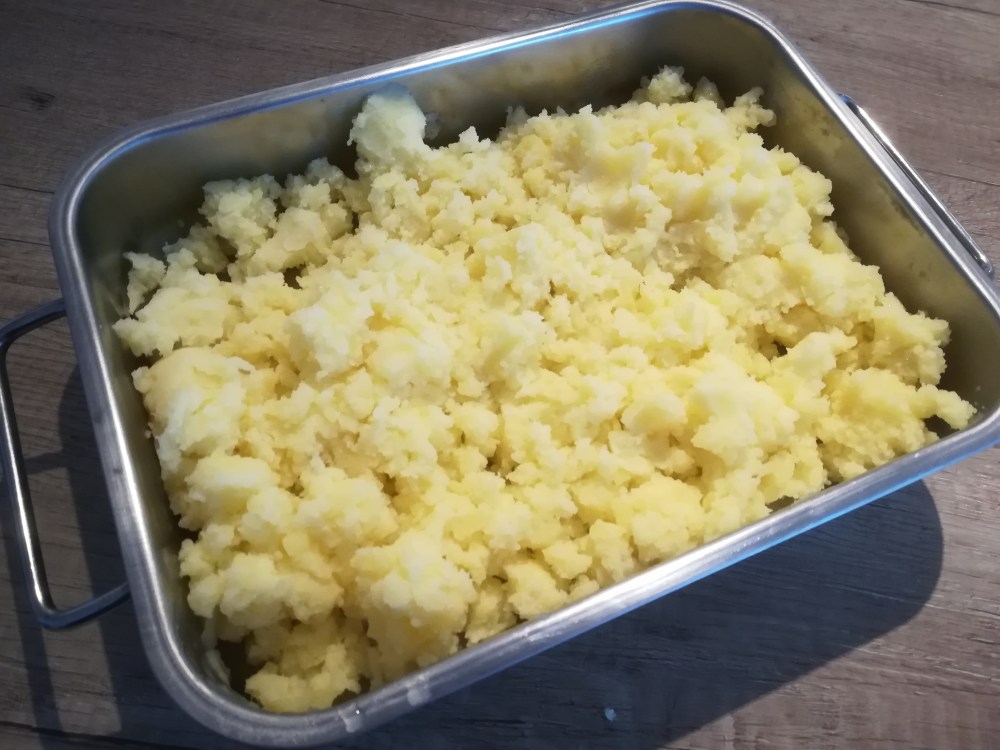
Plate it up all up and enjoy!
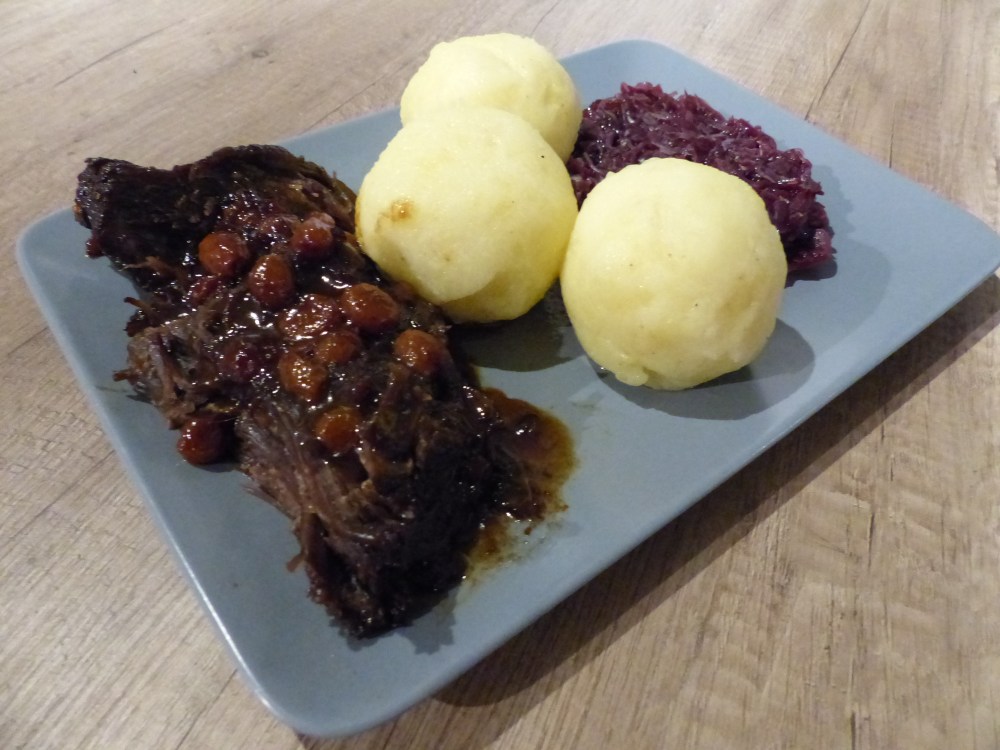
It’s hard to describe the taste of the dish. The meat is indeed very sour and acidic. Do not expect much “beef flavour”, the week-long process of marinating completely removed that. Traditionally it was a dish you made to make tender roasts from a cheap cut of meat. The idea here was not to emphasize and strengthen the taste of the food but to make it tasty no matter how “bad” the original product was. So that’s what you get. It’s super tasty though and the sweetness of the raisins, sugar beet syrup, jelly and Kräuterprinten makes the sauce. It’s a great balancing factor for the taste. It’s a dish you either love or not. I for one love it and it was a nice trip back to my childhood. My grandma did it better, but I think I made a decent homage here. And with that we have it: Germany with the Öcher Suurbrödem.
 Foxcorn